
Jscrambler competitors matter when attackers keep finding cracks in JavaScript defenses, leaving teams exposed to code theft, tampering, and lost IP. As applications grow in complexity and value, security leaders are looking for alternatives that deliver more than basic obfuscation.
Open-source tools like Obfuscator.io, UglifyJS, and JavaScript Obfuscator provide basic obfuscation, but they rarely deliver the depth enterprises need. They lack CI/CD integration, cover only client-side JavaScript, and offer no ongoing support. By contrast, enterprise-grade solutions such as PreEmptive deliver multi-platform coverage, runtime checks, and tamper detection that extend well beyond the browser.
This guide compares the leading alternatives to Jscrambler, clarifies the tradeoffs between open-source and enterprise options, and details a solution that enables production-ready protection that fits seamlessly into enterprise workflows.
Security leaders rarely wake up thinking, “I need another obfuscator.” Instead, they’re driven by recurring problems that basic tools fail to solve.
When comparing Jscrambler alternatives, the search is usually triggered by these pain points:
When teams compare Jscrambler competitors, the landscape splits into two camps: enterprise-grade solutions built for multi-platform workflows and open-source tools designed mainly for client-side JavaScript.
Here’s how the top options stack up:
Overview: PreEmptive stands out among Jscrambler competitors as the only solution designed to protect applications across the full software landscape — not just browser-based JavaScript. It secures .NET, Java, Android, MAUI, and desktop environments, giving enterprises a unified protection layer that scales with diverse development stacks.
For teams that need specialized JavaScript protection, PreEmptive JSDefender delivers industry-leading obfuscation, tamper detection, and anti-debugging features for client-side applications. Together, JSDefender and PreEmptive’s broader toolset provide full-stack application defense — from web and mobile to backend services — all integrated into CI/CD pipelines for consistent, automated protection.
Unlike open-source tools that stop at obfuscation, PreEmptive combines code hardening with runtime checks, tamper detection, and anti-debugging features that actively defend against real-world threats.
Just as important, it integrates directly into CI/CD workflows so security becomes an automated, repeatable step in the development lifecycle rather than an afterthought. The result is production-ready protection that keeps pace with modern release cycles while reducing the risk of IP theft, tampering, and compliance failures.
Pros:
Cons:
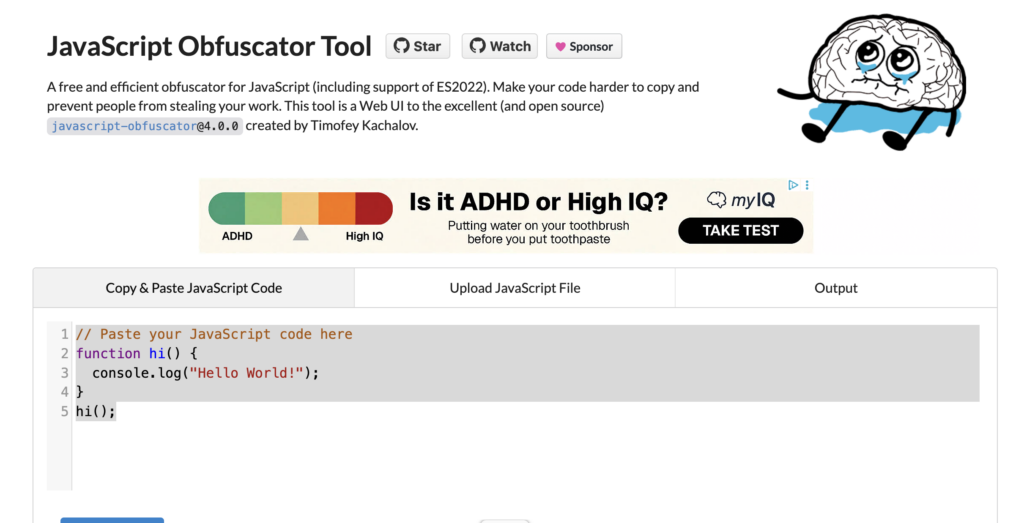
Overview: Obfuscator.io is a free, browser-based JavaScript obfuscator designed for quick use cases. It’s a go-to choice for developers who need a simple way to hide code during early-stage projects or proofs of concept. With configurable settings like string encoding and control flow flattening, it provides a stronger layer of code hiding than simple minifiers, but it lacks the automation and scalability that larger teams demand.
Pros:
Cons:
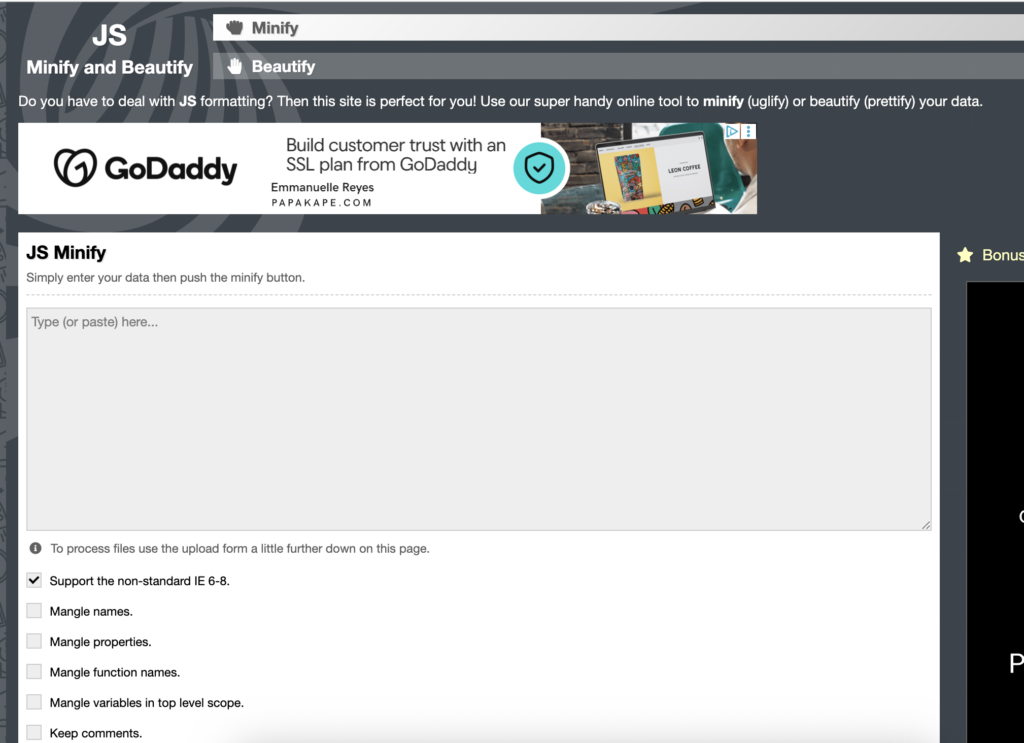
Overview: UglifyJS is one of the most widely adopted tools for compressing and minifying JavaScript. While its core strength lies in optimizing performance by reducing file size, it also includes some obfuscation features that make code less readable. Many development teams use it as part of a build process to ship faster, smaller apps, but it should be seen primarily as a performance optimizer rather than a true security solution.
Pros:
Cons:
No dedicated support — entirely community-driven
Overview: JavaScript Obfuscator is a desktop-based, open-source utility that offers a simple way to scramble code before deployment. It’s straightforward and useful for individual developers who want to quickly obscure source code, but its desktop-only nature makes it difficult to fit into modern CI/CD workflows. While it provides a step up from raw code deployment, enterprises will quickly outgrow its limited feature set.
Pros:
Cons:
Overview: Google Closure Compiler is a sophisticated optimizer that compiles JavaScript into more efficient code, often dramatically reducing file size. Obfuscation is a secondary feature, but it does add complexity to code as part of the compilation process, making it harder to reverse engineer. While powerful, it’s not focused on security — its real value lies in performance optimization. Teams that adopt Closure Compiler often do so for speed gains rather than for robust application protection.
Pros:
Cons:
| Tool | Type | Strengths | Limitations |
| Jscrambler | Commercial JavaScript obfuscation and RASP-lite | Well-known brand; strong client-side JavaScript obfuscation; offers some runtime self-defense features | Primarily focused on JavaScript; limited multi-platform coverage; higher cost than open-source |
| PreEmptive | Enterprise-grade, multi-platform protection | Multi-platform support (.NET, Java, Android, MAUI, desktop); runtime checks; tamper detection; CI/CD integration; enterprise support | Paid solution; may exceed needs of small teams |
| Obfuscator.io | Lightweight online tool | Free; easy to use online; customizable obfuscation settings; suitable for small projects | No CI/CD integration; JavaScript only; no runtime protections; no support |
| UglifyJS | JavaScript minifier and obfuscator | Popular; file size reduction; simple build integration | Limited obfuscation; no enterprise support; no runtime protections |
| JavaScript Obfuscator | Free desktop utility | Free; easy local use; basic obfuscation; minimal setup required | Manual process; JavaScript only; no runtime/tamper defenses; inconsistent updates |
| Google Closure Compiler | Optimizer with obfuscation features | Backed by Google; strong performance optimization; adds some obfuscation; active development | Complex setup; obfuscation secondary to optimization; no runtime protections; not security-focused |
When viewed side by side, the differences become clear.
Open-source tools and optimizers are useful for small projects, but they lack the scalability, automation, and multi-platform coverage that enterprises require. Jscrambler itself improves on these gaps but remains focused narrowly on client-side JavaScript.
PreEmptive stands out as the only solution that unifies protection across platforms, integrates with enterprise workflows, and adds active defenses without slowing development.
Many Jscrambler competitors focus narrowly on obfuscating JavaScript, but enterprises need protection that extends across the entire software ecosystem.
PreEmptive was built for this challenge, providing security that not only hides code but actively defends it during runtime. By covering multiple languages, platforms, and development workflows, it closes gaps left by both open-source utilities and JavaScript-only tools.
Multi-platform protection
PreEmptive secures applications written in .NET, Java, Android, MAUI, desktop, and server-side code, not just browser-based JavaScript. This unified coverage reduces risk and eliminates the need for multiple niche tools.
Enterprise-ready integration
Unlike open-source competitors, PreEmptive integrates directly into CI/CD pipelines, ensuring protection is automated and consistent across every build and deployment.
Beyond obfuscation
PreEmptive includes runtime checks, anti-debugging, and tamper detection that stop active threats, something obfuscation-only tools simply cannot deliver.
Support and updates
Backed by a dedicated team, PreEmptive provides ongoing updates, enterprise-grade support, and documentation, ensuring protection evolves with the threat landscape.
Efficiency without overhead
Unlike full RASP solutions that can slow performance, PreEmptive offers practical, production-ready defenses that keep development speed and user experience intact.
When the goal is real application protection — not just basic obfuscation — PreEmptive stands out as the clear alternative to Jscrambler and other competitors. Its multi-platform coverage, runtime defenses, and CI/CD integration give enterprises a single, reliable layer of protection that fits naturally into modern development pipelines.
Secure every layer of your applications — from JavaScript to .NET, Android, and beyond — with protection that scales as fast as you build.
Request your free trial now and put enterprise-grade security directly into your development workflow.
The most common Jscrambler competitors include PreEmptive, Obfuscator.io, UglifyJS, JavaScript Obfuscator, and Google Closure Compiler. PreEmptive is the only enterprise-grade option, offering multi-platform coverage, CI/CD integration, and runtime defenses. The others are mainly open-source tools suited for small projects.
Jscrambler is a commercial solution that focuses on client-side JavaScript obfuscation with some runtime protection features. It is not open-source, which means ongoing use comes with licensing costs.
Organizations often explore alternatives because Jscrambler is limited to JavaScript-only protection. Enterprises managing mixed environments need solutions like PreEmptive that can secure .NET, Java, Android, desktop, and server-side code as well.
For enterprises, PreEmptive is the leading Jscrambler competitor. It delivers multi-platform security, integrates seamlessly into CI/CD workflows, and provides runtime defenses like tamper detection and anti-debugging.
Free tools like Obfuscator.io, UglifyJS, and JavaScript Obfuscator can obscure code but stop short of enterprise needs. They lack CI/CD integration, don’t scale across platforms, and don’t provide active runtime protection. They’re useful for small apps but not for enterprise-grade security.
Yes. PreEmptive not only replaces Jscrambler but also expands protection across multiple languages and platforms. It automates security within the development lifecycle and includes defenses that make applications harder to reverse engineer, tamper with, or debug.