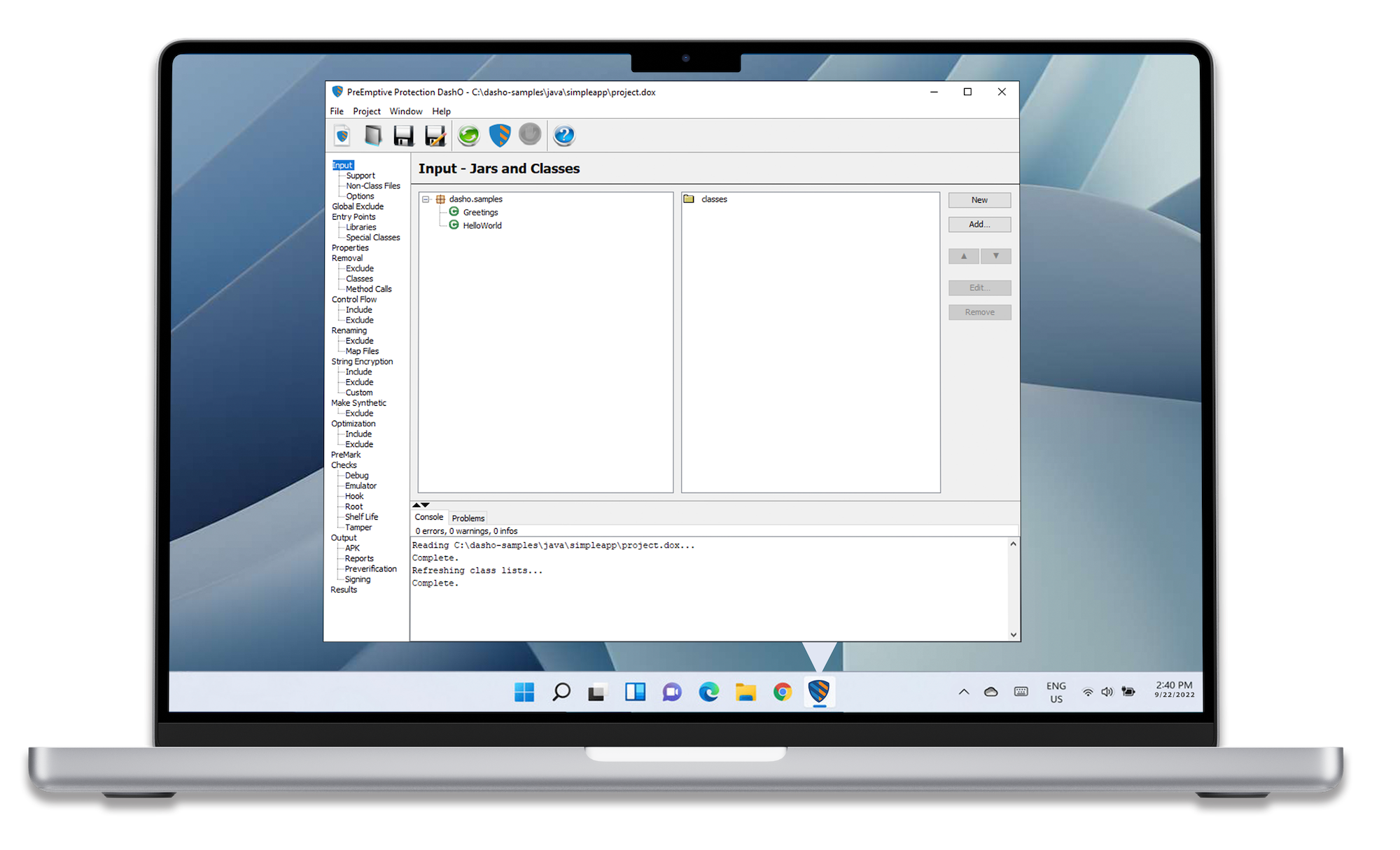
DASHO

slash-separator

Java Security and Android Obfuscator

DashO protects Android, Java, and Kotlin applications from reverse engineering, code tampering, and unauthorized debugging
dasho header 1

Multiple security layers. One build step. Zero code changes

Two Decades of Java and Android App Protection

slash-separator-grey
Microsoft
Merrill-Lynch-logo
Barclays-Logo.svg 1
Boeing_full_logo.svg 1
Symantec_logo

Why DashO?

DashO helps protect applications from reverse engineering, tampering, runtime attacks, and unauthorized debugging. Applied at build time, DashO adds layered protections that make deployed applications harder to analyze, modify, and exploit.
Protect Against Reverse Engineering
Make decompiled code harder to understand with layered obfuscation designed to reduce code readability.
prevent, stop reverse engineering
Detect Code Tampering
Identify unauthorized modification and trigger defensive responses when tampering is detected.
runtime protection, checks, integrity, against modification
Protect Intellectual Property
Layered protection makes proprietary logic harder to analyze, follow, and reuse.
Protect IP
Secure Sensitive Strings
Encrypt sensitive strings to make it significantly harder for attackers to locate valuable data in compiled code.
string encryption
Defend Runtime Attacks
Detect risky runtime environments such as rooted devices, emulators, and hooking frameworks.
android root
Stop Unauthorized Debugging
Identify debugging attempts and respond automatically based on your security configuratio
Anti-Emulator
5 star header
Proven protection against reverse engineering
“It provides an advanced control flow feature and destroys the code pattern that the decompilers are using to create the code. The final code is exactly the same as the original, but no decompilers can guess the originally written code, even when using high-end technology.”
— Lokender Y., Software Developer
As Reviewed on G2

Explore the protection DashO brings to deployed applications.

The DashO Approach

DashO combines multiple protection layers to help secure compiled Android, Java, and Kotlin applications from reverse engineering, code tampering, and runtime threats.

Advanced Code Hardening

slash-separator-Blue-800
before and after code obfuscation
control flow obfuscation
code removal, reduce exposed attack surface 1
string encryption
Patented Overload Induction Renaming
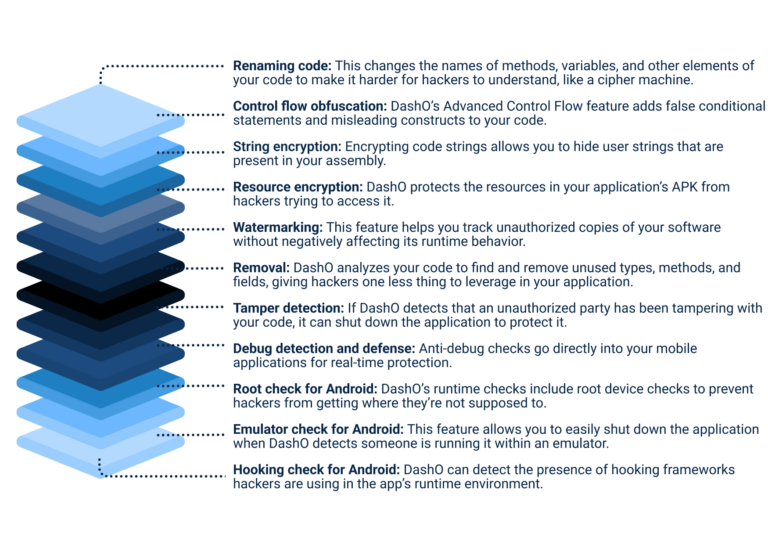
DashO’s patented Overload Induction renames as many methods as possible to identical names, making the decompiled output much harder to interpret.
Control Flow Obfuscation
DashO transforms bytecode structure to make decompiled logic harder to follow and less useful to attackers.
Resource Encryption & Removal
DashO can encrypt resources and remove unused methods, debug symbols, and logging calls to reduce the exposed attack surface.
String Encryption
DashO encrypts selected strings in compiled code and decrypts them at runtime to help protect sensitive values from easy extraction.

Real-time Defense System

slash-separator-Blue-800
runtime protection, checks, integrity, against modification 6
debug protection 3
expiry mechanism 2
digital watermarking to protect IP
Anti-Emulator
Tamper Detection & Defense
DashO injects integrity checks throughout the application to detect modification or repackaging and trigger configured defenses.
Debug Detection & Defense
DashO detects debugging activity through multiple runtime checks and can respond with force exit, defensive logic, or altered behavior.
Shelf Life
DashO can embed expiration logic into application code so teams can limit how long a build remains usable.
Watermarking
DashO can embed unique identifiers into builds to help trace unauthorized redistribution or repackaging.
Android Runtime Checks
DashO detects rooted devices, emulators, and hooking frameworks, then responds based on your configuration.

See DashO in action

Start a free DashO trial to explore layered obfuscation, tamper detection, runtime protection, and string encryption.
Before
After

Frequently Asked Questions

Android applications compile to bytecode designed to preserve program structure for cross-platform execution. This same feature makes it possible for the applications to be decompiled. Without obfuscation, your intellectual property, proprietary algorithms, API keys, and security mechanisms are visible to anyone with basic reverse engineering skills.

Add DashO early in development to catch integration issues before release. For existing applications, DashO integrates through Gradle, Maven, or command line tools with minimal configuration changes.

App hardening combines multiple security techniques to make applications resistant to attack: obfuscation against reverse engineering, runtime checks to detect tampering and debugging, and automated defensive responses. DashO provides hardening through multiple integrated protection layers.

DashO protects Android applications, Java desktop applications, and Kotlin applications on any platform where Java runs. It processes compiled bytecode, so the original development language and target platform do not affect functionality.

DashO applies many protections at build time, including obfuscation and renaming, with little to no direct runtime impact. Runtime defenses, such as tamper, debug, and environment checks, may add some overhead depending on your configuration. Teams can tune these protections to balance security and performance.

Yes. DashO focuses on obfuscation and runtime protection for deployed applications, while other security tools may help with activities like vulnerability scanning, code analysis, and testing earlier in the software lifecycle. Used together, these tools can support a more layered application security strategy.
© 2026 PreEmptive. All Rights Reserved